/ Overview
AEMO's participant registration process relied on 33 PDF forms that applicants downloaded, completed offline, and emailed back for manual review. Each form carried complex conditional logic, branching rules, and validation requirements. The process created high effort for applicants and heavy admin workload for AEMO teams.
I led end-to-end UX for a digital registrations portal that replaced the offline process with structured online submission for organisations and an admin portal for AEMO teams to review, request changes, approve, or reject applications. With 27 forms in scope and a 3 to 6 month delivery window, the core design challenge was making the programme shippable without designing every form individually.
/ Problem statement
AEMO's registration process was entirely offline. Applicants interpreted complex conditional rules without guidance, completed sections manually, and emailed submissions for review. AEMO teams processed these through email threads with limited visibility across submission status.
This created compounding issues. Applicants had no structured way to navigate conditional logic, leading to incomplete or incorrect submissions. The Registration Team carried heavy manual review workload. There was no shared system connecting applicant progress, admin review, and organisational handoffs.
With 27 forms in scope and deep conditional complexity, the project risked being too large to deliver within a 3 to 6 month window without a scalable design strategy.
The design challenge was not just digitising forms. It was creating a delivery model that could handle volume and complexity while giving applicants a clearer experience and giving AEMO teams structured review capability.
/ My role
Working end-to-end UX for the applicant submission journey and key admin review patterns, I worked with Business Analysts to translate regulatory rules, data fields, validations, and conditional logic into buildable form flows.
I partnered with Power Pages developers to co-create a platform-aligned UI kit meeting AEMO branding, accessibility expectations, and technical constraints.
My key contribution was reframing the delivery approach. Instead of designing 27 forms individually, I proposed five reusable form archetypes plus one complex proof of concept, then prototyped the most complex NEM Generator flow end to end to de-risk feasibility, support engineering estimates, and secure stakeholder buy-in.
/ Approach
Mapped the current workflow
I audited the existing PDF-based registration process, where applicants downloaded forms, completed them offline, and emailed AEMO for manual review.
I mapped the ecosystem of users and handoffs across organisations, the AEMO Registration Team, and Support Hub to clarify responsibilities, bottlenecks, and error points.
I also reviewed BA requirements, field lists, validations, and branching rules to understand complexity drivers and identify repeatable patterns across forms.
Defined a scalable delivery model
I framed the core challenge as scale plus complexity: digitising many forms with deep conditional logic under a tight 3 to 6 month delivery window.
Instead of designing 27 forms individually, I proposed a reusable delivery model: five hi-fi form archetypes covering the main form families, plus one complex proof of concept to de-risk feasibility and support engineering estimates.
This aligned stakeholders around a practical v1: a portal submission workflow with an admin review loop, rather than a perfect redesign of every form variation at once.
Designed build-ready patterns
I co-designed lo-fi wireframes with BAs to lock in information architecture, step structure, and rule interpretation before moving into hi-fi.
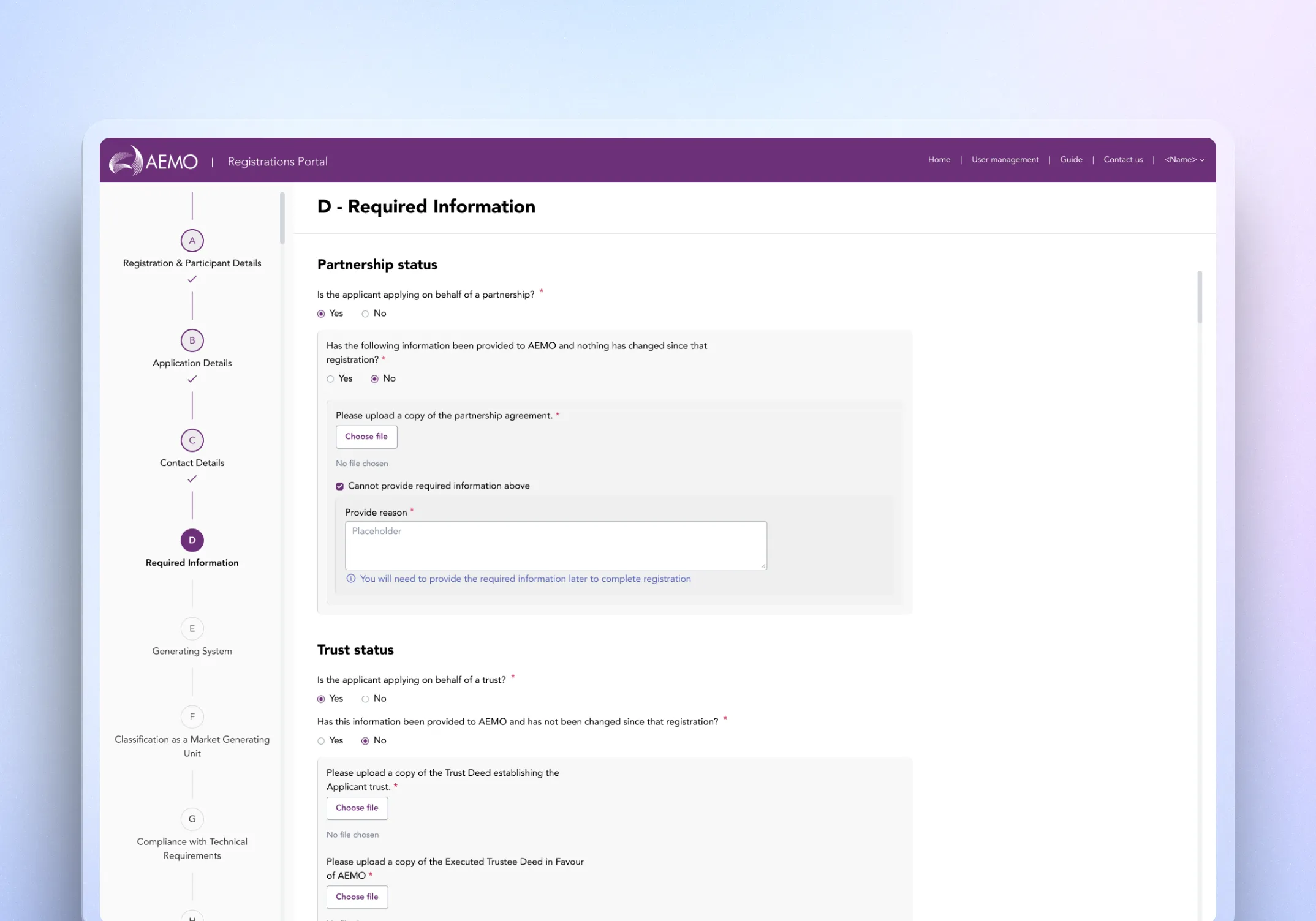
I designed a non-sequential completion model requested by the business, using a vertical stepper so applicants could skip, complete, and return to sections rather than follow a forced linear flow.
I created a conditional logic visual system to reduce cognitive load:
Conditional sections appear in light grey containers
Nested conditions use deeper tones to show hierarchy
A subtle left border connects nested sections, using a familiar “thread” mental model to show dependency
I also built a Power Pages-aligned UI kit with developers to standardise typography, spacing, components, and states while staying within platform constraints.
/
AI &
Design workflow
Map the registration ecosystem
Audited the offline PDF process and mapped users, handoffs, and bottlenecks across applicant organisations, AEMO Registration, and the Support Hub.Define a scalable delivery model
Reframed the programme from 27 individual form designs into five reusable archetypes plus one complex proof of concept, making delivery scope realistic for both design and engineering.Design conditional form patterns
Created a non-sequential stepper, tonal conditional containers with depth-based nesting, and a threaded left-border system to help applicants navigate complex branching without losing context.Prototype the most complex journey
Built an end-to-end clickable prototype of the NEM Generator flow, using Figma Make AI to accelerate linking across conditional paths. This turned static requirements into a decision-ready artefact for workshops and stakeholder sign-off.Build a platform-aligned UI kit
Co-designed a Power Pages-ready component kit with developers, documenting buildable components, spacing rules, and states for consistent implementation.
/ Challenges & Solutions
27 forms in scope with a 3 to 6 month window
Reframed the approach from bespoke form design to archetype-based delivery. Five archetypes covered the main form families, and one complex proof of concept validated feasibility. This reduced design effort and gave engineers a repeatable build pattern.
Stakeholders struggled to review conditional logic in static requirements
Created a clickable prototype of the most complex journey, using Figma Make AI to accelerate linking and keep workshops focused on decisions. This led to faster alignment and contributed to additional budget approval.
Complex conditional logic needed to feel navigable
Designed a visual system using tonal containers for conditional relevance, deeper tones for nesting hierarchy, and a threaded left border for dependency. Combined with a non-sequential stepper, this gave applicants control without hiding form structure.
/ Outcome & next steps
This project modernised AEMO's registration workflow by replacing offline PDFs and email-based handling with a structured digital portal for applicants and an admin review loop for AEMO teams. The portal was designed to reduce incomplete submissions and give AEMO teams structured visibility across application status.
My core contribution was making a large, complex programme shippable under tight constraints. The archetype-based delivery model reduced bespoke design effort across 27 forms, the platform-aligned UI kit improved design-to-build consistency, and the end-to-end prototype de-risked feasibility and supported stakeholder confidence. Accessibility considerations shaped contrast, focus states, and component sizing throughout the design process.
Next steps would include WCAG validation, usability testing with internal AEMO teams and external applicant organisations, and extending the archetype library as more form types move through delivery.
Below is a recording of the clickable Figma Make AI prototype. Feel free to have a click around yourself here.